

Meal deals are a mainstay of the convenience channel, but their continued success isn’t just about price or promotion. Instead, they reflect how shoppers behave in-store – how quickly they decide, what they prioritise, and what they expect from a solution in the moment.
Looking at shopper behaviour over the latest 12 months, a clear pattern emerges: meal deals work because they align with the realities of convenience shopping: speed, simplicity, and immediacy.
A Shopper Defined by Time Pressure
The typical meal deal shopper is firmly rooted in the working population, with strong representation among those aged 25–44 and a smaller share among older consumers.
There is also a slight skew towards male shoppers, alongside a notable over-index among more affluent households.
Taken together, this points to a distinct shopper profile: one that is less driven by price sensitivity alone, and more by the need for quick, reliable solutions during busy routines.
Meal deals succeed in this context because they remove friction, offering a ready-made answer when time is limited.
The Core Mission Is Immediate
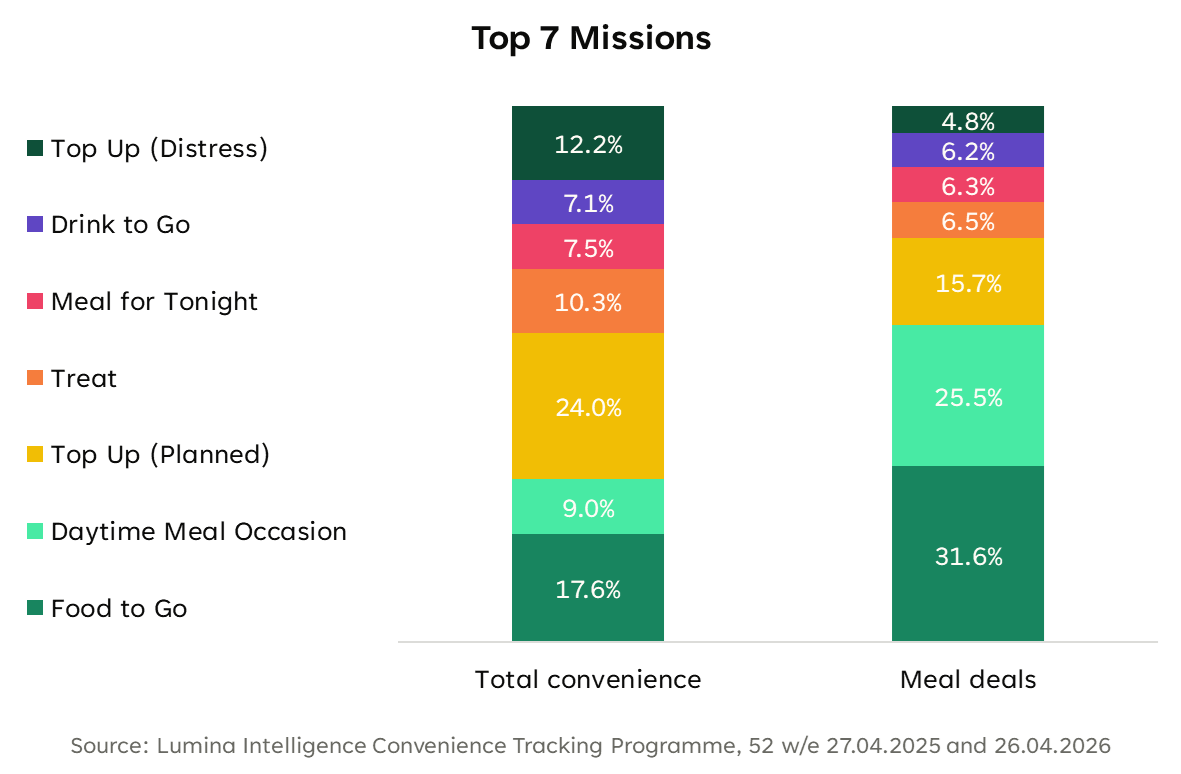
Meal deal purchases are closely tied to lunchtime behaviour, particularly when shoppers are looking for something quick and convenient. Lunch and lunch-on-the-go missions account for a significant share of purchases, reinforcing the role of meal deals as a core food-to-go solution.
However, the role of the meal deal is not static. While it is still used for treats, snacks and top-up shops, some of these more discretionary occasions are beginning to shift.
This highlights an important distinction: meal deals are at their strongest when they meet an immediate, functional need, rather than a more considered or indulgent one.
Decisions Are Made in Seconds
In convenience, decision-making is fast. Shoppers are not comparing multiple options or evaluating every component of a deal. Instead, they rely on quick cues to guide their choice; what they recognise, what they trust, and what stands out.
Brand plays a leading role in this process, alongside price, but visibility in-store is also critical in shaping the final decision.
In practice, this means the effectiveness of a meal deal is not just determined by its contents, but by how easily it can be understood and selected in the moment.
The Familiar Still Dominates But Change Is Emerging
Despite innovation across convenience, shopper behaviour within meal deals remains anchored in familiar combinations.
The classic format – typically built around a main, a drink and a snack – continues to dominate, underlining the importance of habit and routine in this mission.
At the same time, there are signs of gradual change. Shopper choices are beginning to shift at the edges, with growing interest in alternative options beyond traditional components.
These changes are subtle but suggest that shoppers are open to adjustments that better suit their needs.
Value Is Becoming More Complex
Meal deals are intrinsically linked to value, with all purchases tied to promotional behaviour.
However, value is no longer defined by price alone. Brand, quality and health all play a role in shaping how shoppers evaluate an offer, pointing to a more layered decision-making process than might be expected in a convenience setting.
At the same time, changes in the wider promotional landscape suggest that meal deals are operating in an increasingly competitive environment.
A More Selective Meal Deal Shopper
There are early indications that shopper behaviour around meal deals is becoming more selective.
Some discretionary missions are softening, while usage remains strongest in clearly defined, functional moments. This suggests that shoppers are placing greater importance on when a meal deal truly delivers value.
Rather than declining in relevance, meal deals are becoming more focused, centred on occasions where they provide a clear and immediate benefit.
What Comes Next
The convenience meal deal shopper is driven by time pressure, habit, and the need for simplicity.
This creates a clear challenge for retailers and brands: success depends less on reinventing the format, and more on aligning with how shoppers actually behave in-store.
However, beneath this simplicity sits a more nuanced picture. Shopper expectations are evolving, decision drivers are becoming more layered, and small shifts in behaviour are beginning to reshape the category.
About the data
These insights have been powered by Lumina Intelligence’s Meal Deal Monitor, a continuous, data‑led view of how meal deals are priced, built and performing across retail and foodservice – connecting real shopper behaviour with real‑world execution.
3,000 consumer interviews per quarter capturing missions, frequency, trade-up and the drivers of value perception.
FAQs
What defines a convenience meal deal shopper?
A convenience meal deal shopper is typically driven by time pressure, prioritising quick, simple choices during fast, in-the-moment purchasing occasions.
Why are meal deals important in convenience retail?
Meal deals play a key role in meeting immediate food-to-go missions, offering a ready-made solution that removes decision friction for shoppers.
How does the convenience meal deal shopper make decisions?
The convenience meal deal shopper tends to make rapid decisions, relying on familiarity, visibility and trusted brands rather than detailed comparison.
Is price the main driver for the convenience meal deal shopper?
While value is important, the convenience meal deal shopper also considers factors like quality, brand and ease when selecting a meal deal.
When are meal deals most commonly purchased?
Meal deals are most strongly linked to lunchtime and on-the-go missions, where speed and convenience are the top priorities.
Is the behaviour of the convenience meal deal shopper changing?
There are early signs that the convenience meal deal shopper is becoming more selective, with subtle shifts in how and when meal deals are used.
What do brands need to understand about the convenience meal deal shopper?
Success depends on aligning with the shopper’s need for speed, simplicity and clarity, while adapting to evolving expectations within the category.