

The UK restaurant sector has entered 2026 against a backdrop of economic caution and evolving consumer priorities. Data from Lumina Intelligence shows that while participation in eating out has declined, consumer spend per visit and visit frequency continue to rise. Growth is being driven by higher spending and more deliberate dining choices rather than an increase in overall occasions.
According to Lumina Intelligence market sizing, the UK restaurant market was valued at £18.5 billion in 2025, declining by 2.0% year on year, as rising operating costs, outlet closures and shifting consumer behaviour weighed on performance. Despite this contraction, demand remains resilient in premium, experience-led and quality-focused formats.
Restaurant Spending Trends
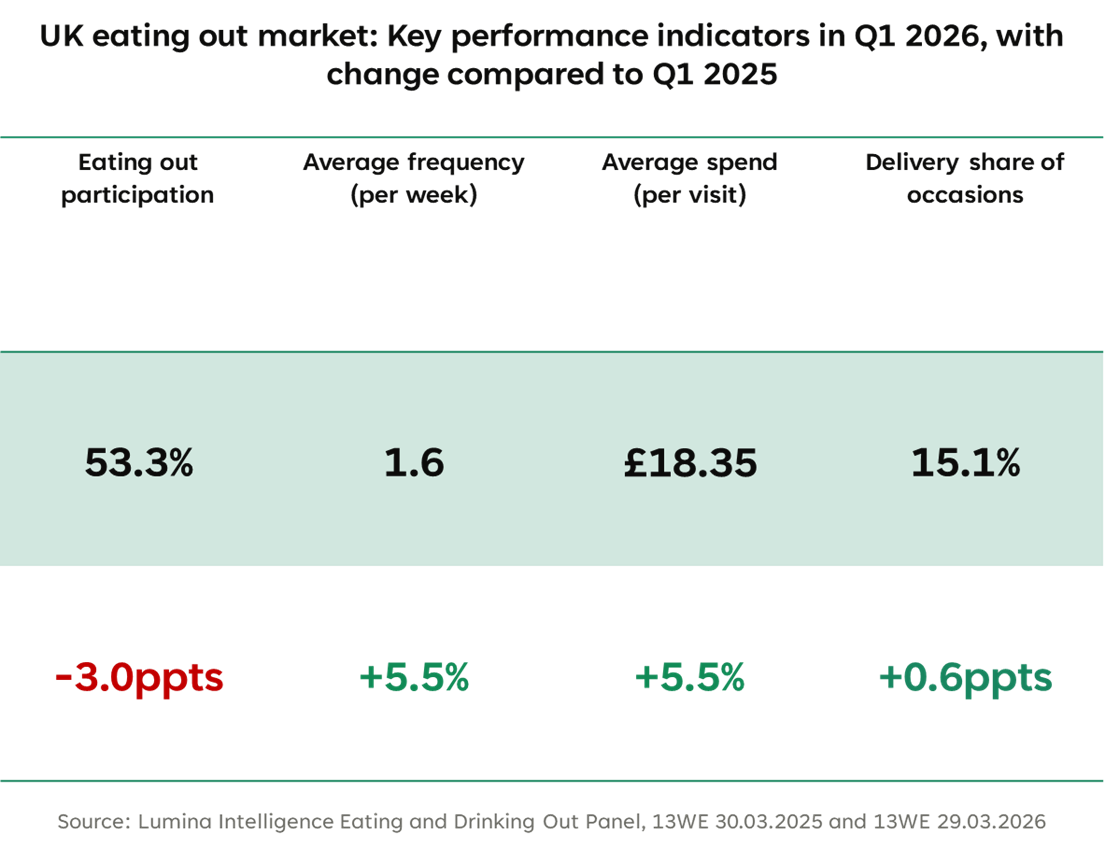
Average spend per visit continues to rise, even as overall participation in eating out declines. In Q1 2026, average spend per eating-out visit reached £18.35, representing a 5.5% increase year on year, driven primarily by menu price inflation and cost pass-through by operators.
While consumer confidence has weakened, diners are increasingly willing to spend more when they do eat out. This reflects a growing tendency to prioritise value for money, quality and experience over frequency. Consumers are consolidating visits and trading up within fewer, more intentional occasions rather than increasing casual or spontaneous trips.
Premium casual dining has benefited most from this shift, as brands that combine accessible pricing with higher-quality food and atmosphere continue to outperform the wider restaurant market.
Are Consumers Dining Out More Often?
Despite rising spend and frequency metrics, participation in eating out fell to 53.3% in Q1 2026, a decline of 3 percentage points year on year, marking the lowest level since Q3 2021. This decline reflects heightened financial anxiety, declining consumer confidence and geopolitical uncertainty during the quarter.
However, those who remain active in the eating-out market are dining slightly more often. Average visit frequency increased to 1.6 visits per week, up 5.5% year on year, indicating that demand remains concentrated among engaged, higher-spending consumers.
Consumers are more selective about when and why they eat out. Dining occasions are increasingly planned, purpose-led and budget-aware, with a noticeable reduction in drink-only and impulse visits.
Which Consumers Are Driving Restaurant Growth?
The 25 to 34 age group continues to be the most important driver of restaurant demand. In Q1 2026, this cohort accounted for 24.1% of eating-out occasions, an increase of 1.5 percentage points year on year, making them the largest and fastest-growing segment.
This demographic shows strong engagement with social dining, premium casual formats and branded experiences. They are more willing to prioritise eating out even amid cost-of-living pressures, particularly for occasions that deliver perceived quality and value.
In contrast, consumers aged 55 to 64 reduced their share of occasions as financial strain and rising economic inactivity prompted reduced discretionary spend. Eating out is also becoming more solitary, with occasions involving solo diners increasing, while partner and group visits declined.
What Restaurant Consumers Value Most
Consumer decision-making is increasingly shaped by quality, value and brand trust. In Q1 2026, quality-led consumers accounted for nearly 80% of occasions, making this the most dominant mindset in the eating-out market.
Value remains a critical consideration, particularly in the context of rising prices, while brand familiarity and loyalty continue to grow in importance. Health-led choices are also increasing steadily, reflecting ongoing interest in balanced meals and ingredient quality, although ethical and sustainability concerns now play a smaller role than in previous years.
Key drivers of restaurant choice now include:
- Perceived value for money
- Quality of ingredients
- Familiarity and trust in the brand
- Convenience and proximity
- Menu choice and breadth
Restaurants that clearly communicate food quality, consistency and relevance to specific dining missions are best positioned to justify higher spend per visit.
Changing Dining Occasions
Dining occasions are becoming more polarised across the week. Weekend dining remains the most valuable occasion, while weekday visits face increased competition from retail, food-to-go and delivery.
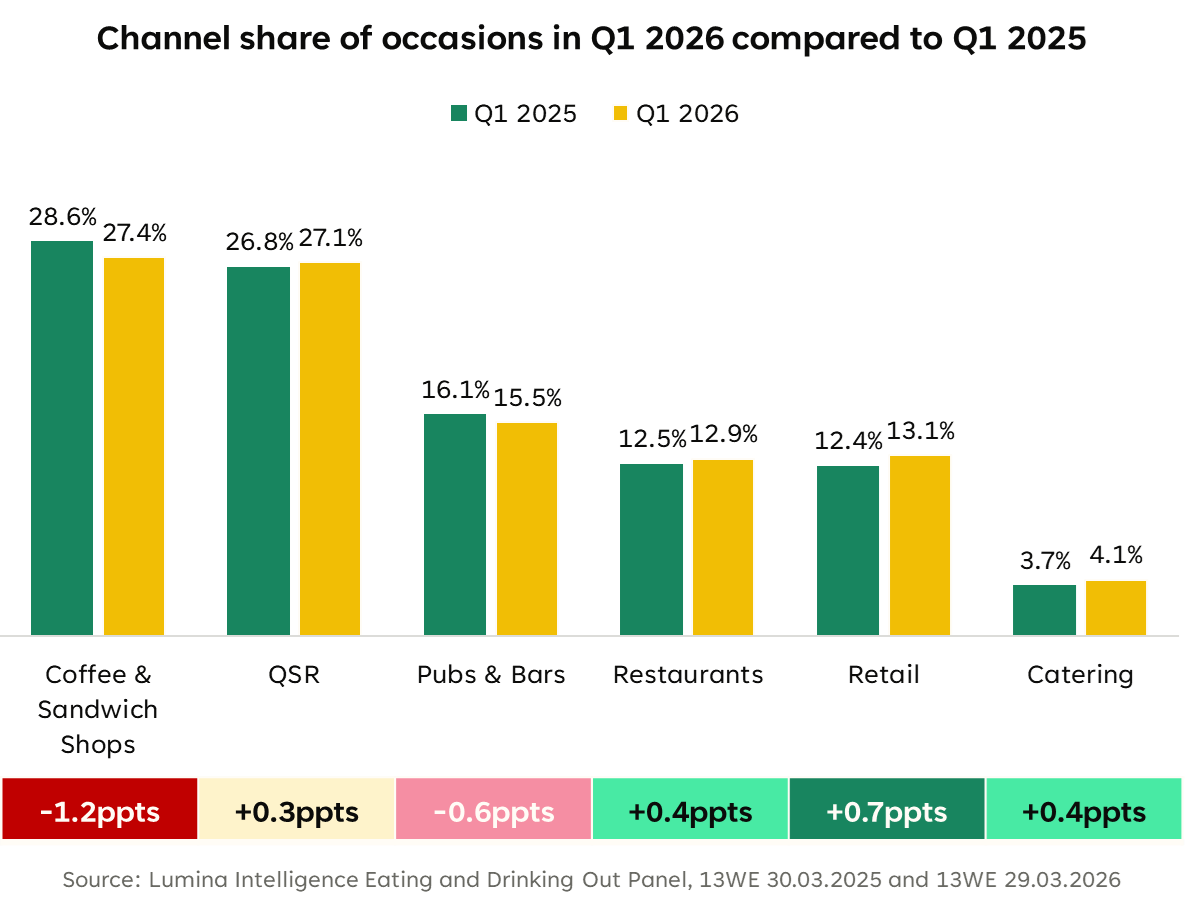
Snacking has emerged as the fastest-growing occasion in Q1 2026, gaining 0.9 percentage points year on year, as consumers adopt flexible eating patterns and look for more affordable or functional options. Lunch and dinner occasions declined in share, although both delivered increases in spend and participation among those continuing to dine out.
Restaurants are under increasing competitive pressure at weekday lunch, even as remaining lunch occasions generate higher spend and frequency. In response, operators are refining lunch menus, introducing sharper value offers and improving service speed to protect footfall.
UK Restaurant Market Outlook
The UK restaurant sector faces ongoing cost pressures, including wage inflation, business rates and energy costs, which continue to shape estate strategies and investment decisions. Outlet numbers declined by 1.0% in 2025, with independent and branded operators closing underperforming sites to focus on efficiency and profitability.
At the same time, premium casual and fine dining segments demonstrate that growth is still achievable where propositions align with consumer demand for quality, experience and differentiation.
Looking ahead, the market is expected to stabilise rather than rebound sharply. Future growth will depend less on increasing visit frequency and more on capturing higher spend, strengthening brand relevance and delivering dining experiences that feel purposeful, worthwhile and consistent.
About the data
The insights in this article are from Lumina Intelligence’s Eating and Drinking Out Panel (EDOP), built on 78,000 annual surveys across 900+ operators, this solution provides a nationally representative view of UK out-of-home eating and drinking behaviour across dine-in, takeaway, and delivery occasions. For more information or tailored insight, visit lumina-intelligence.com
What are the biggest UK restaurant consumer trends in 2026?
Rising spend per visit, greater focus on quality and value, growth of premium casual dining and more intentional dining occasions.
Are UK consumers spending more at restaurants?
Yes. Average spend per visit increased by 5.5% year on year in Q1 2026, driven primarily by price inflation and selective trading up.
Which age group drives restaurant demand the most?
Consumers aged 25 to 34 account for the largest share of restaurant occasions and are the strongest contributors to growth.
Are people dining out less often?
Overall participation has declined, but those who continue to dine out are visiting slightly more frequently and spending more per visit.
What is the outlook for the UK restaurant market?
Modest growth is expected, with success concentrated among operators offering strong value propositions, high-quality food and experience-led dining.