


The UK food economy is entering a more complex phase. Growth across the wider economy is expected to remain relatively subdued as inflationary pressure, rising employer costs and global uncertainty continue to affect businesses and consumers.
Spending is increasingly shifting between channels depending on convenience, price perception and lifestyle needs. In practice, three areas of the market capture this shift particularly clearly:
- eating out
- foodservice delivery
- convenience and food-to-go retail
Each reflects a different way consumers are managing food occasions in a more uncertain economic environment.
Industry forecasts published in 2025 suggest these structural shifts will continue shaping UK food consumption patterns through 2026 and beyond.
Where Food Spending Is Concentrating
Eating out continues to dominate the UK foodservice landscape. The market was forecast to reach £101 billion in 2025, with growth supported by segments such as retail, travel and leisure and contract catering.
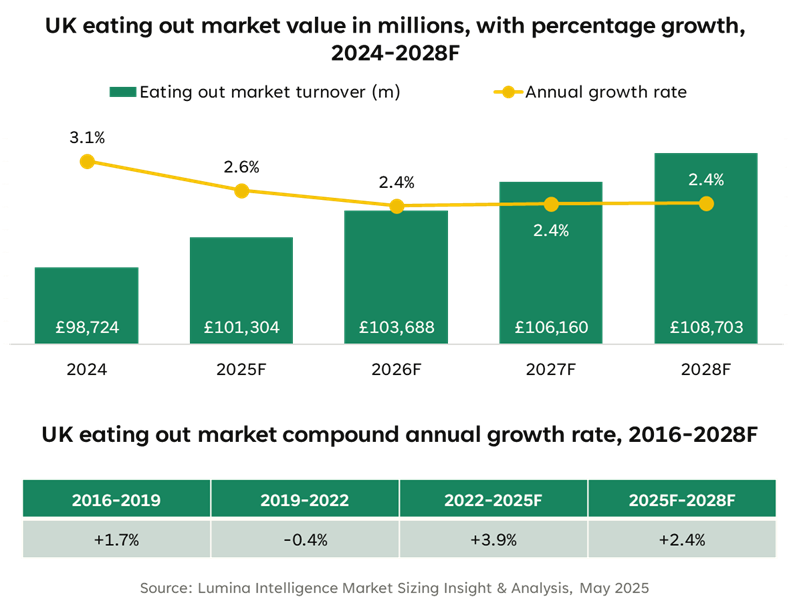
Our data points at further expansion over the next few years. Market value is projected to reach £108.7 billion by 2028, with growth settling at around 2.4% annually as inflation pressures ease and operators adjust their business models.
That growth is not evenly spread: quick service channels, particularly fast food, sandwich & bakery and coffee shops, are expanding their share of the market. Flexible formats, franchising models and ongoing menu innovation have allowed these operators to scale more quickly.
More traditional service-led venues face a tougher environment. Restaurants and pubs are among the most exposed to labour costs, business rates and operating pressures. As those costs continue to rise, the gap between faster formats and full-service venues is widening.
Eating Out: Changing Missions
Consumer motivations for eating out are also shifting.
The traditional “treat” occasion still plays an important role, but other motivations are becoming more prominent. Meals linked to relaxing, socialising or taking a break from work or study are gaining share.
These occasions tend to favour formats that are quick, accessible and perceived as good value. This partly explains the continued expansion of quick service operators across high streets, travel hubs and retail locations.
At the same time, diners are paying closer attention to factors such as food quality, ingredient standards and healthier options when choosing where to eat.
Eating out has not become less important to consumers. The occasions themselves have become more routine and part of their daily lives.
Delivery: A Channel That Has Settled
The delivery market has moved beyond the surge experienced during the pandemic and is now expanding at a steadier pace.
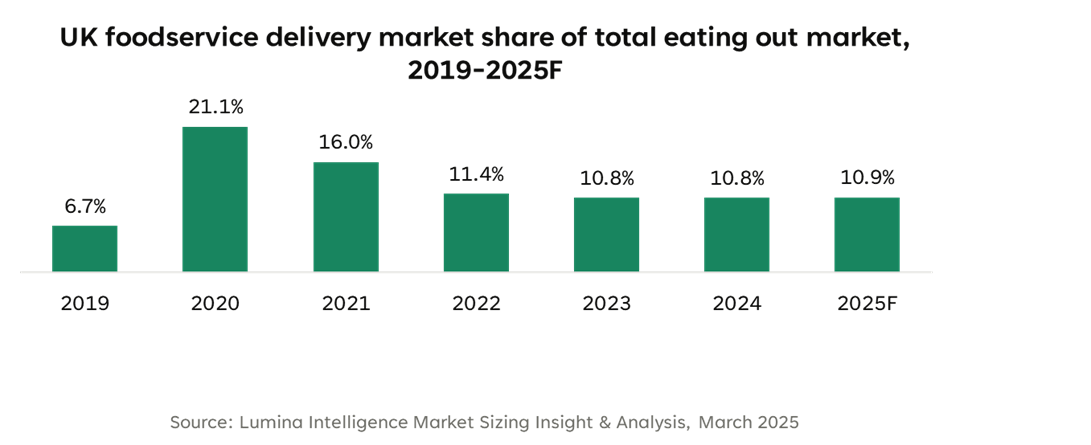
Market value was forecasted to reach £14.3 billion in 2025, supported by platform innovation, wider delivery availability and the growth of delivery-only kitchens.
Delivery represented around 10.9% of the total eating out market in 2025. That share is expected to increase gradually as platforms refine their services and expand into additional occasions.
Consumer participation has also strengthened. Around 10.6% of the population now order delivery in an average week, and ordering frequency continues to edge upwards.
Growth in delivery is not evenly distributed across the population.
Usage is particularly concentrated among:
- consumers aged 25–34
- higher-income households
- urban populations
These groups are more willing to pay the additional fees associated with delivery and are also more likely to integrate delivery into regular routines.
For them, delivery is increasingly just another way to access foodservice rather than an occasional indulgence.
Convenience Retail: Everyday Consumption
While delivery attracts a great deal of attention, convenience retail remains a major part of the food economy.
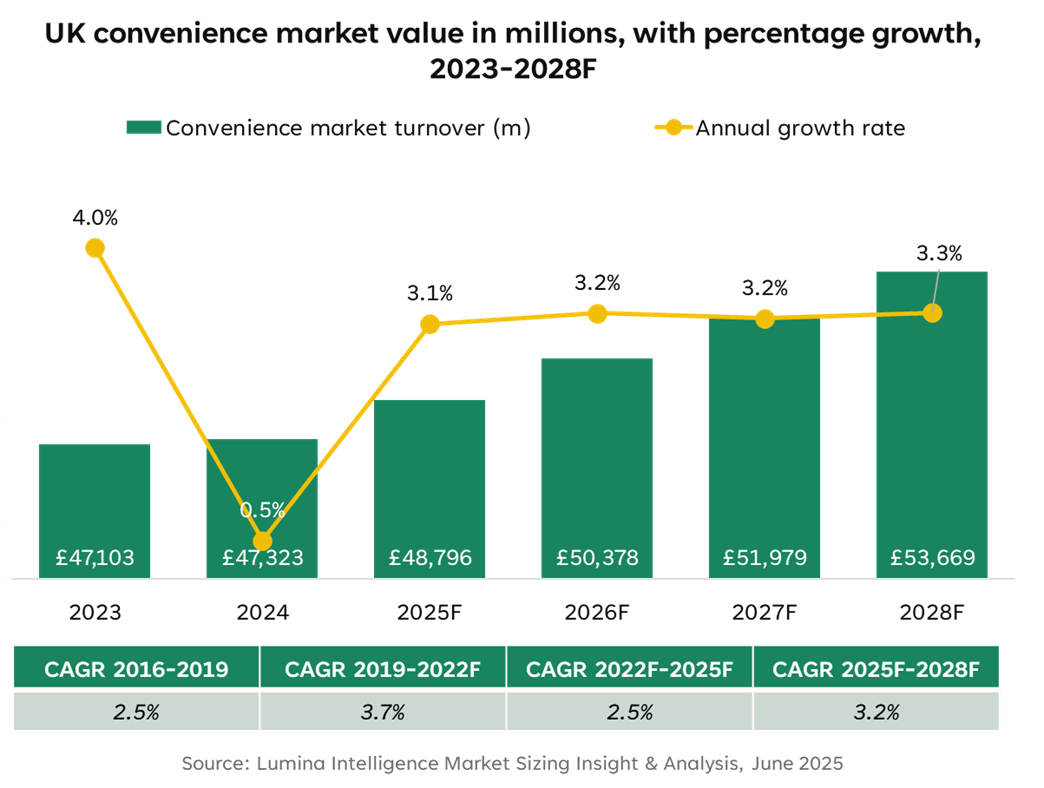
The UK convenience market was valued at £47.3 billion in 2024 and was expected to grow to £48.8 billion in 2025, representing growth of just over 3%.
Longer-term projections suggest the market could reach £53.7 billion by 2028.
Several structural factors underpin this growth:
- Consumers have increasingly returned to top-up shopping missions, particularly as hybrid working patterns continue.
- Demand for food-to-go and fresh categories has also increased, encouraging retailers to expand ranges and invest in store upgrades.
- Shopping behaviour has also shifted in subtle ways. Instead of large weekly shops, many consumers now make more frequent, smaller visits, a pattern often described as “little and often”. Convenience stores are well positioned to capture these missions.
A More Polarised Spending Pattern
One of the most visible changes across the food market is the growing gap between consumer groups.
Higher-income households have largely maintained their spending patterns and in some cases increased their use of delivery and premium food options.
Other consumers are more cautious. Value perception has become central to decision-making, particularly when choosing where to eat out or which products to buy.
Quality and health considerations are also increasingly influential. Consumers are not necessarily trading down in terms of expectations; instead they are balancing price with perceived value.
This combination of pressures is creating a more segmented market environment.
Three Channels, Different Roles
Delivery, convenience retail and eating out increasingly serve different purposes within consumers’ lives.
Eating out remains closely associated with social occasions, leisure and experiences. Delivery tends to be used when convenience is the priority – particularly among younger, urban and higher-income consumers. Convenience retail, meanwhile, captures everyday purchases, immediate consumption and quick top-up shopping.
Rather than competing directly, these channels are becoming part of a broader ecosystem of food consumption.
Market Outlook to 2028
Across the sector, growth forecasts point to steady expansion rather than rapid acceleration.
The UK eating out market is projected to reach £108.7 billion by 2028, growing at roughly 2.4% per year.
The foodservice delivery market is expected to reach £15.8 billion by 2028, supported by continued platform development and operational innovation.
The convenience market is forecast to expand to £53.7 billion by 2028, reflecting its role in everyday shopping missions.
Economic uncertainty is likely to remain a feature of the market. Even so, demand for food occasions remains resilient.
Implications for Operators
Operators across the sector are responding to these shifts in different ways.
Restaurants and hospitality groups are investing in automation, new formats and differentiated concepts in an effort to manage rising costs while maintaining consumer interest.
Delivery platforms are focusing on technology improvements, loyalty initiatives and partnerships with operators to encourage more frequent ordering.
Convenience retailers continue to expand food-to-go ranges, upgrade stores and integrate technology to improve efficiency and speed of service.
The overall direction of travel is clear. The UK food market is becoming more fragmented, with different channels capturing different occasions rather than competing for the same ones.
The insight within this article
The insights found in this article have been sourced from the following Lumina Intelligence market reports:
UK Eating Out Market Report 2025
The Lumina Intelligence UK Eating Out Report 2025 is the trusted source of insight for UK leading manufacturers and operators. This detailed report quantifies the size and growth of the channel and market forecasts up to 2028, with a detailed look at growth drivers and potential inhibitors.
UK Foodservice Delivery Market Report 2025
The UK Foodservice Delivery Market Report 2025 is the definitive source of insight into the UK’s foodservice delivery sector. This report provides in-depth analysis of market trends, consumer behaviour, competitive dynamics, and growth opportunities.
Convenience and Wholesale Market Report 2025
The UK Convenience & Wholesale Market Report 2025 brings together proprietary data across retailer and shopper touchpoints to build a complete view of the convenience and wholesale ecosystem.
FAQs
Are UK consumers eating out less in 2026?
Not necessarily. The UK eating out market continues to grow overall, although consumer behaviour is becoming more selective. Many consumers are prioritising value and quality when choosing where to spend, which has led to stronger growth in quick service formats such as fast food, coffee shops and sandwich & bakery outlets compared with traditional full-service venues.
How big is the UK eating out market expected to be?
Industry forecasts suggest the UK eating out market will reach around £108.7 billion by 2028, growing steadily from approximately £101 billion in 2025. Growth is expected to stabilise at around 2.4% per year, reflecting a more mature and competitive market environment.
How important is delivery to the eating out market?
Foodservice delivery has become a permanent part of the eating out ecosystem. Delivery is expected to account for around 10.9% of the UK eating out market in 2025, with its share gradually increasing as digital platforms expand and consumers integrate delivery into everyday routines.
Why are convenience stores growing in importance?
Convenience retail has benefited from changing shopping habits, particularly the rise of top-up shopping missions and more frequent smaller trips. Consumers are increasingly using convenience stores for immediate purchases, food-to-go and everyday essentials, supporting steady growth in the sector.
What factors are shaping UK food consumption trends?
Several structural trends are influencing how consumers buy food:
- inflation and pressure on household budgets
- changing work patterns, including hybrid working
- growth of delivery platforms and digital ordering
- demand for convenience and speed
- increasing focus on food quality and healthier options
Together, these factors are reshaping how consumers allocate food spending across eating out, delivery and retail channels.
What is the outlook for the UK food market over the next few years?
The outlook suggests steady but moderate growth across the sector. Eating out, delivery and convenience retail are all expected to expand, although at different rates. Rather than competing directly, these channels are increasingly serving different consumer needs — from social dining experiences to quick meals and everyday shopping.