

The UK food-to-go market enters 2026 in a more disciplined position than at any point in the past five years. Growth is steady rather than explosive. Expansion is more selective. And the battle for spend is being fought through smarter pricing, sharper propositions and clearer quality cues.
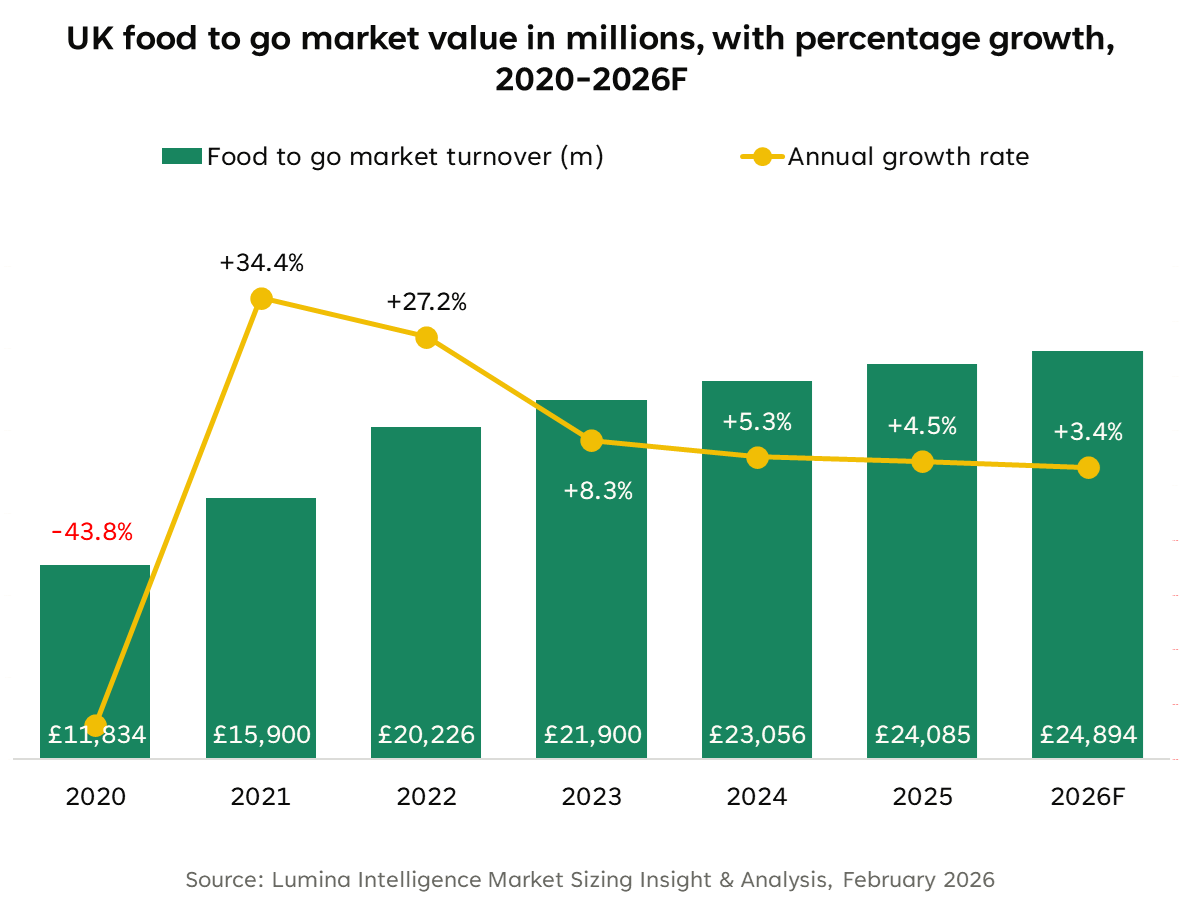
The market is forecast to reach £24.9 billion in 2026, rising +3.4% year on year and continuing to outperform the wider eating out sector. Yet this uplift is not being driven by rapid outlet rollout. Instead, higher spend per visit, premium add-ons and tighter value engineering are doing most of the work.
Return-to-office mandates, rail usage above pre-pandemic levels and stronger city-centre footfall are reinforcing commuter-led demand. At the same time, consumers are redefining value. Price still matters, but quality, health credentials and brand trust now play a central role in justifying spend.
For operators and suppliers, 2026 is less about chasing volume and more about protecting margin, consolidating share and refining format strategy.
Key statistics: UK food-to-go market 2026
Growth is holding firm in 2026, but the mechanics have shifted. This is a market driven by spend, sharper value positioning and growing brand consolidation rather than rapid space expansion.
- £24.9bn forecast market value in 2026
- Outperforming the wider eating out market (+2.4%)
- £12.98 average spend per visit, up +8.5% year on year
- 33.3% of total market turnover controlled by the top 10 brands
- Food to go set to increase its share of the total eating out market beyond pre-pandemic levels
- Net outlet growth slowing to +0.9% as operators prioritise efficiency over aggressive rollout
UK food-to-go market size 2026
The UK food-to-go market is forecast to value £24.9 billion in 2026, reflecting a +3.4% uplift year on year. Food to go’s momentum in 2026 is less about rebound and more about structural advantage. While wider hospitality remains exposed to cautious discretionary spend, food to go benefits from routine-led demand, commuter concentration and flexible formats that can respond quickly to shifts in consumer behaviour.
The result is a channel that is quietly widening its lead over total eating out, strengthening share through relevance rather than scale.
UK food-to-go market growth
Year-on-year growth (2025–2026)
Food to go is forecast to grow +3.4% in 2026. While outlet growth is moderating due to labour and regulatory pressures, value growth remains intact.
Spend per visit has increased to £12.98, up +8.5% year on year. This suggests that premiumisation, add-ons and structured bundles are driving more of the uplift than footfall alone.
Growth drivers in 2026
Hybrid working patterns have stabilised, concentrating demand around office days and commuter corridors. Nearly half of businesses now expect five days on site, driving stronger city-centre trade. National rail usage has exceeded 2019 levels, reinforcing travel-linked occasions.
Value remains central, but its meaning has shifted. Consumers increasingly define value through quality signals rather than price alone. At the same time, 78% of food-to-go consumers describe themselves as quality driven.
Premiumisation is visible across both retail and foodservice. Functional health, ingredient provenance and elevated classics are supporting higher price points.
Travel hubs are becoming more influential. Some 29.2% of food-to-go occasions now take place in travel hubs, up year on year.
UK food-to-go market share statistics 2026
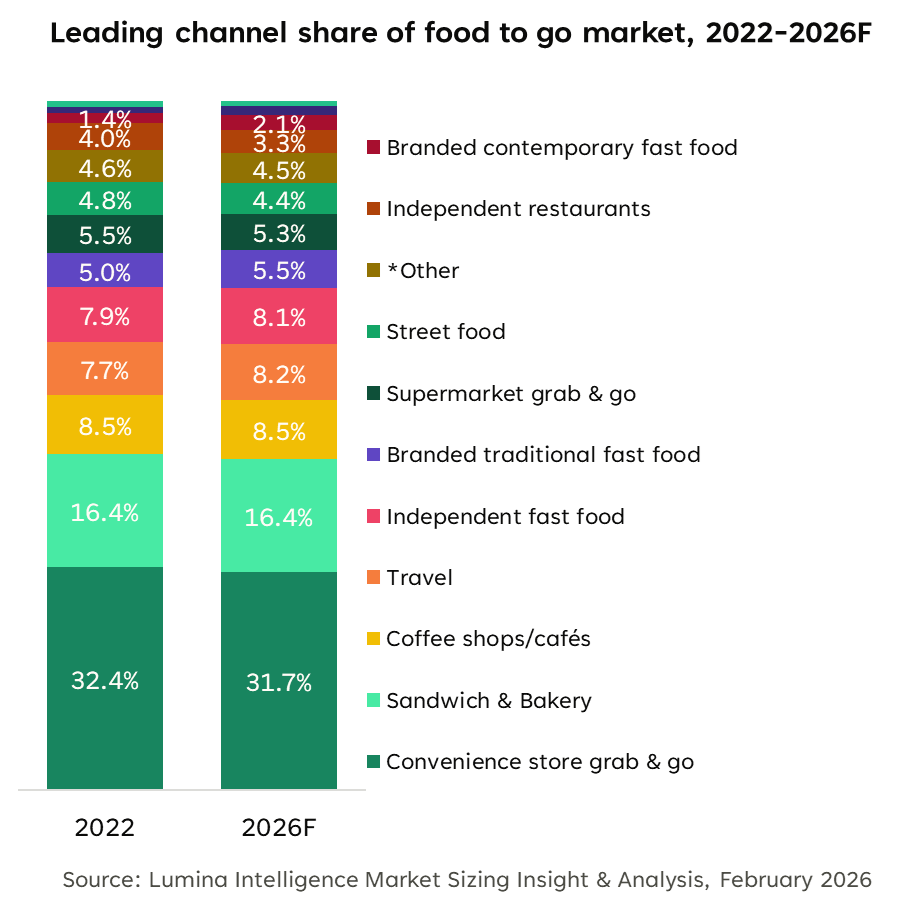
Market share by channel
Convenience store grab-and-go remains the largest value segment of the market. Supermarkets and traditional fast food are set to gain share in 2026, reflecting sustained demand for value and broadened ranges.
The top 10 brands account for over a third of the total market at 33.3%. Leading operators have strengthened positions through product innovation, estate optimisation and digital integration.
QSR continues to gain traction in food-to-go occasions, benefiting from speed, perceived value and broader menu development.
Competitive landscape
The top 10 food-to-go brands delivered combined turnover of £8bn in 2025, up +5.2% year on year. Some highlights:
- Greggs grew total sales +6.6% year on year, supported by estate expansion and digital adoption. Its app now features in over a quarter of transactions, allowing more targeted pricing and frequency management.
- Marks & Spencer has expanded its Food on the Move proposition, launching hundreds of new products and gaining share through innovation and premium positioning.
Across the board, estate strategy is becoming more selective. Rising staff costs and regulatory pressures are curbing net new openings, pushing operators to prioritise efficiency and format refinement.
Conclusion
Food to go in 2026 is defined by control rather than acceleration. The easy gains from post-pandemic recovery have passed. What remains is a structurally resilient channel that understands its customer missions, adapts quickly to economic pressure and competes through proposition strength rather than footprint alone. Operators that balance credible value with visible quality, invest selectively in high-footfall locations and use data to refine pricing and range will be best placed to extend share.
About the data
These insights have been powered by the Lumina Intelligence UK Food to Go Market Report 2026. The report delivers a comprehensive view of a sector navigating cost pressures, evolving consumer routines and sustained demand for convenience.
Positioned as both a review of recent market performance and a forward-looking outlook to 2028, the report equips operators, suppliers and investors with the insight needed to understand shifting demand, refine proposition strategy and make confident decisions in the evolving food-to-go landscape.
FAQs
What is the UK food-to-go market size in 2026?
The UK food-to-go market is forecast to reach £24.9 billion in 2026, continuing to outperform the wider eating out sector despite a more cautious consumer backdrop.
How fast is the UK food-to-go market growing?
The market is forecast to grow +3.4% year on year in 2026. Growth is being driven primarily by higher spend per visit rather than rapid outlet expansion.
Is growth coming from more customers or higher spend?
Growth is largely spend-led. Average spend per visit has risen to £12.98, reflecting premium add-ons, bundled deals and sharper pricing architecture rather than a significant rise in participation.
Which channels hold the largest share of the food-to-go market?
Convenience store grab-and-go remains the largest value segment. Supermarkets and traditional fast food are also gaining share through expanded ranges and stronger value positioning.
Are travel hubs important for food-to-go growth?
Yes. Travel hubs account for a growing share of food-to-go occasions, supported by rail usage above pre-pandemic levels and stronger commuter footfall.
How concentrated is the UK food-to-go market?
The top 10 brands account for 33.3% of total market turnover, highlighting increasing consolidation among leading operators.
What are the main growth drivers in 2026?
Stabilised hybrid working patterns, commuter-led demand, premiumisation, functional health innovation and sharper value communication are central to growth in 2026.
Is outlet expansion still driving the market?
Outlet growth is moderating. Operators are prioritising operational efficiency, estate optimisation and targeted format expansion over aggressive site rollout.