

Consumer value perception in the UK is changing rapidly in 2026. UK consumers are no longer defining value purely by price, but by quality, experience and trust.
For much of the past decade, value in food, drink and hospitality was effectively shorthand for price. Lower cost signalled better value, and promotions were a reliable way to trigger demand. In 2026, that assumption no longer holds.
Evidence from Lumina Intelligence shows that UK consumers now judge value through a broader mix of quality, experience, health and emotional return, with price acting as confirmation rather than the starting point. This shift is shaping everyday purchasing decisions across retail and foodservice.
How Consumer Value Perception in the UK Is Shifting from Price to Quality
Seventy-one per cent of UK consumers now say they prioritise quality over price when choosing food and drink. This preference has strengthened since 2024, despite continued cost-of-living pressure. Rather than focusing solely on price, consumers increasingly assess whether a product delivers reliable quality, enjoyment and reassurance once the transaction is complete.
This shift is reinforced by the fact that eighty per cent of UK consumers believe healthy ingredients should not compromise taste, signalling that pleasure and wellbeing are now baseline expectations rather than trade-offs.

Why Price Matters Less in UK Consumer Value Perception
Price has not disappeared from decision-making, but its role has changed. Lumina Intelligence data suggests that heavy discounting is increasingly met with scepticism, particularly among quality-led consumers. Large promotions can raise doubts around standards and integrity rather than signalling genuine value.
Instead, consumers increasingly look for fair pricing: prices that feel consistent, transparent and proportionate to what is delivered. Importantly, those who prioritise fairness are still willing to pay more, provided quality feels earned rather than exaggerated.
Value Is Now Experienced, Not Calculated
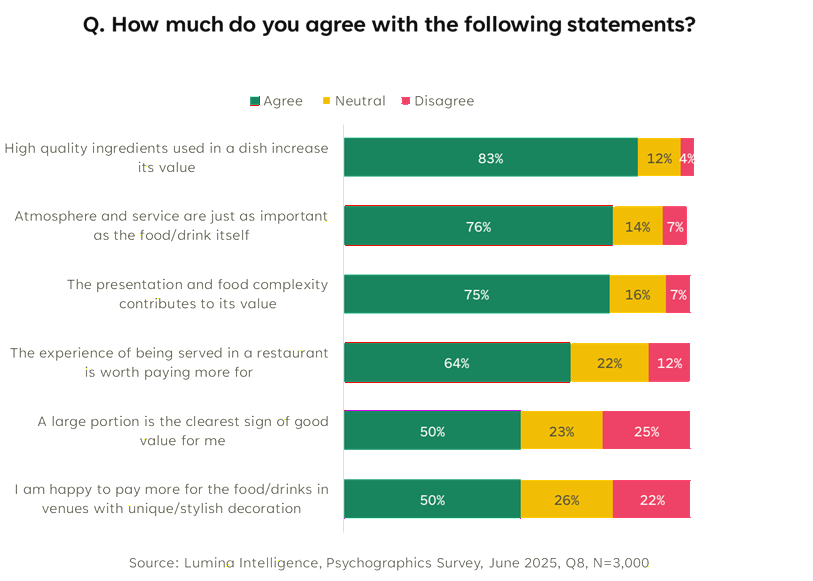
When assessing value for money when eating out, consumers continue to rank high-quality ingredients as the strongest driver. However, they now rate atmosphere and service as equally important as the food itself, followed closely by presentation and overall experience.
This indicates that value is increasingly judged retrospectively, based on whether the experience feels worth it once it’s over, rather than calculated upfront on price alone.
Value Differs by Generation
Younger UK consumers are more likely to reward experience, presentation and social proof when judging value, while older consumers anchor value in ingredient quality, provenance and reliability. Although the language of value is shared, its practical meaning varies by age.
What This Redefinition of Value Means
Taken together, the evidence points to a clear conclusion: price alone cannot engineer value. Price reductions are now a weaker and riskier lever, while visible quality cues, consistent experience and trust do more of the work in justifying spend.

About the data
The insights in this article are from The Modern UK Consumer 2026, Lumina Intelligence’s definitive exploration of how UK consumer mindsets, values and behaviours are evolving across food, drink, retail and eating out.
Based on an annual survey of 3,000 UK adults, the report moves beyond demographics to reveal the psychological drivers shaping choice unpacking how consumers now balance value, quality, health, experience, brand trust and convenience in an increasingly polarised economic and cultural landscape.
FAQs
What does value mean to UK consumers in 2026?
Value is defined as perceived worth rather than low price. Data from Lumina Intelligence shows that most UK consumers judge value through quality, taste, experience, health cues and fairness, with price acting as a secondary validation.
Do UK consumers still care about price?
Yes, but price now acts as a sense-check rather than a decision anchor. Consumers remain budget-aware but increasingly prioritise quality and experience when deciding whether something feels worth the money.
Why are discounts becoming less effective?
Heavy discounting is increasingly associated with lower quality and reduced trust. Lumina Intelligence data shows consumers respond more positively to fair and consistent pricing than to deep or erratic promotions.
How do consumers judge value when eating out?
Value when eating out is driven first by high-quality ingredients, but atmosphere, service and overall experience are now equally important in determining whether spend feels justified.
How does value perception differ by age?
Younger consumers place more emphasis on experience, presentation and social proof, while older consumers prioritise ingredient quality, provenance and reliability. The cues may be shared, but their interpretation differs.
Is the shift away from price-led value temporary?
No. Lumina Intelligence data indicates a multi-year structural shift toward quality-, experience- and trust-led value frameworks that has strengthened since 2024 despite economic pressure.